
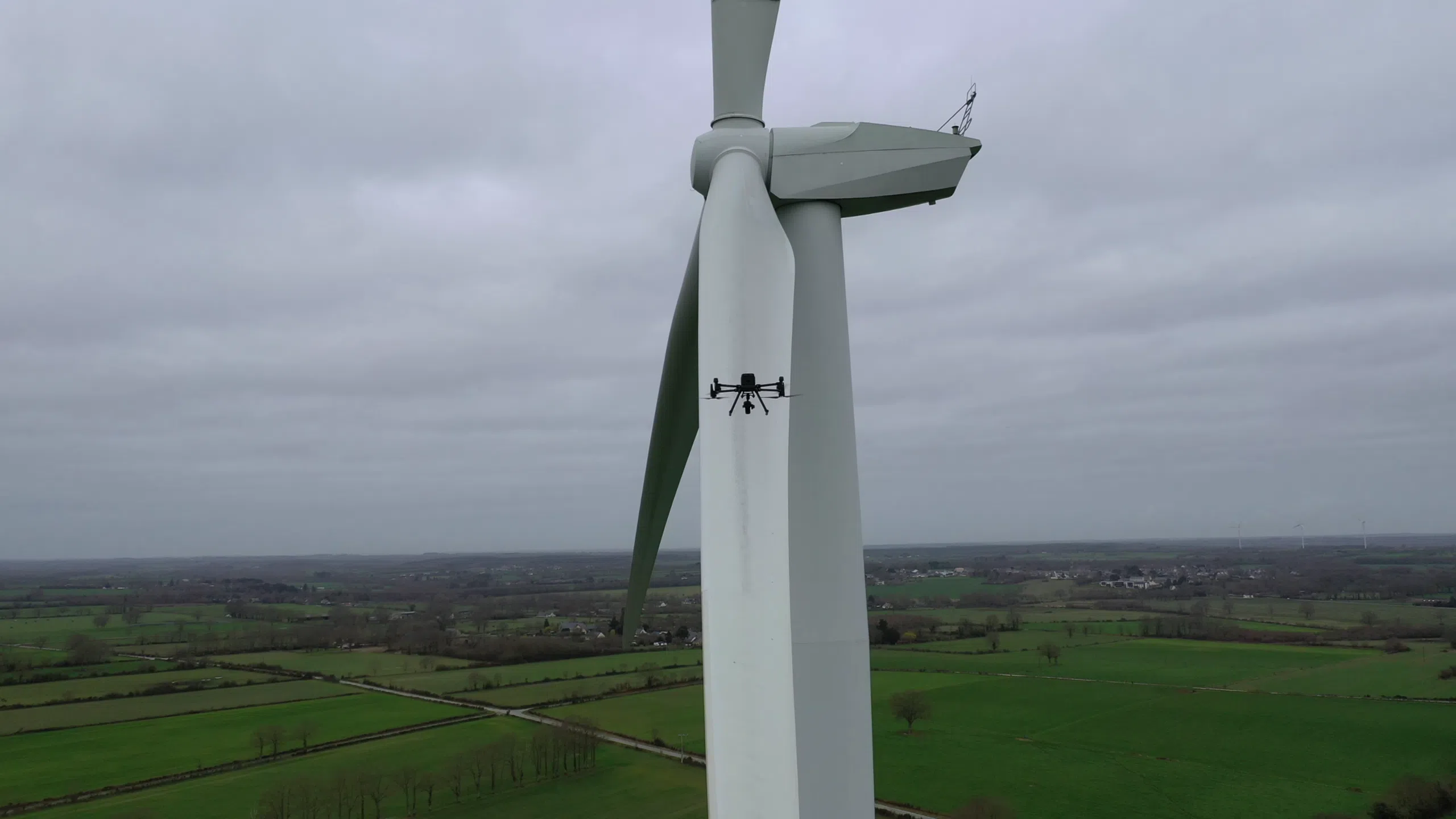
© Inspection with DJI M300, SkyVisor, 2026
Dieser Artikel enthält:
⚠️ This article complements, not replaces, OEM manuals and should always be used alongside limits, contractual requirements, and site-specific policies, providing an operator-focused framework for consistent defect interpretation and triage. It is built on SkyVisor’s experience with hundreds of thousands of defects across multiple blade models.
Wind turbine blades are high-consequence components where small inconsistencies in inspection interpretation translate into large variability in cost, risk, and downtime. At fleet scale, the challenge is not only detecting defects, but also typing them consistently, assessing severity with traceable logic, and selecting actions within realistic repair windows.

At portfolio scale, the risk is not “missing defects.” The risk is inconsistent interpretation that creates inconsistent maintenance decisions.
As inspection volumes increase (more turbines, suppliers), most operators see the same failure pattern:

© Example of LE Erosion vs LEP Damage, SkyVisor, 2026
☝️ Practical consequence: if you cannot compare findings reliably, you cannot prioritize repairs reliably.
To convert findings into defensible actions, each finding must be decision-grade across four dimensions:
| Dimension | Decision-grade requirement | Typical failure mode |
|---|---|---|
| Positioning | Repeatable spanwise + chordwise referencing (zone, side, distance) + blade ID + photo orientation | “Near tip” / “mid-span” language; inconsistent zone systems |
| Description | Standard defect family + subtype + mechanism hypothesis (when possible) | Free text; mixed categories (e.g., erosion + crack) without separation, as categories that mix cause and consequence (e.g., prefer defect type = fibre damage, note/description = burnt fibre, root cause = lightning strike, rather than choosing between “lightning strike damage” and “fibre damage”) |
| Quantification | Length/area/depth proxy, progression indicator, confidence level | No measurement; “small/large” subjective labels |
| Context | Previous history, access constraints, seasonality, turbine model sensitivity, known campaigns | Findings assessed in isolation; no trend |
This distinction between defect type and root-cause hypothesis is particularly important.
For example, rather than treating “lightning strike damage” and “fiber damage” as competing categories, a structured system can record:
Defect type: Fiber damage
Observed description: Burnt or damaged fiber
Root-cause hypothesis: Lightning strike
Confidence: Medium
This preserves what was actually observed while keeping the suspected mechanism separate.

© Lightning damage example with visible fiber damage, SkyVisor, 2026
☝️A finding is “actionable” only when it answers: Where is it? What is it? How big is it? What changed since last time?
SkyVisor Wind all-in-one solution turns drone inspections into a structured, decision-ready workflow by embedding positioning, defect taxonomy, and severity logic directly into reporting.
The SkyVisor WebApp allows users to visualize each turbine in detail, organize findings by category and severity, and generate standardized reports in just a few clicks and seamless collaboration across teams supporting faster, data-driven maintenance decisions.

Repeatable acquisition (distance, angles, coverage, naming) reduces rework and disagreement because it makes it easier to:
When positioning is precise and repeatable, teams can move faster from “debate” to “decision” and can defend that decision later.
Year: 2023
Severity: –
Defect: –
Year: 2024
Severity: Cat 1
Defect: Erosion
Year: 2026
Severity: Cat 2
Defect: Erosion
© Leading edge erosion over 3 years , 2026 SkyVisor
☝️ By prioritizing accurate defect annotation, classification, and categorization, SkyVisor delivers consistent, reliable data to support informed blade maintenance decisions.
SkyVisor DroneApp supports in-house inspections with guided, repeatable acquisition. That repeatability improves image consistency and anchors findings to a precise blade location (spanwise + chordwise references), enabling progression tracking, fleet comparability, and fewer interpretation debates.

At scale, image capture can still be a challenge, but with SkyVisor, it no longer has to be. Once images are captured, the real hurdle becomes consistency: different teams, different vendors, different naming conventions. That’s where AI becomes operationally valuable, not as a replacement for expertise, but as a layer that standardizes and accelerates it.
AI tools can structure the “first pass” of inspection data. They suggest defect families and subtypes with a confidence score. They flag uncertain or high-risk cases. They generate consistent, structured outputs that reduce back-and-forth between teams. The result is faster reporting cycles and cleaner datasets that can actually be compared across sites and over time.
This is where SkyVisor Wind AI plays a practical role. It acts as a consistency engine across your inspection workflow. It helps normalize how anomalies are categorized, highlights discrepancies with previous inspection cycles, and routes findings based on confidence level or potential impact. High-severity or low-confidence items are escalated. Routine cases move faster.
Beyond individual inspections, it enables portfolio-level visibility. You can track recurrence patterns, monitor the progression of specific issues, and identify hotspots across turbines or sites. Because outputs are standardized, maintenance planning, budgeting, and warranty discussions all start from the same structured dataset. That removes ambiguity and reduces friction between stakeholders.

☝️ AI does not replace expert judgment. It makes it scalable, repeatable, and faster to apply across an entire fleet.
Even as AI tools are becoming more and more used, humans must remain accountable for:

☝️ SkyVisor always keeps a human in the loop, ensuring that final responsibility for interpretation and decisions stays with your team. On top of that, it lets you adapt the level of automation depending on operational needs through different analytics packages: Light, Pro, or Expert.
We recommend a robust operating model to bring structure to how data moves from field capture to final operational decisions, ensuring consistency, accountability, and scalability across the entire inspection workflow:
Standardized acquisition + positioning
AI-assisted typing + confidence score
Expert validation for low-confidence / high-consequence findings
Severity assignment + action window mapping
Traceable decision log + trend tracking across cycles
Blade programs don’t fail at scale because operators lack inspection data, they fail because inspection data is not decision-grade. When defect language drifts between stakeholders, severities are applied inconsistently, and decisions live in emails or calls, the outcome is predictable: avoidable downtime, inflated repair spend, missed access windows, and weak defensibility in warranty or insurance discussions.
This article proposes a practical operator framework to close that gap. By standardizing a defect taxonomy, calibrating severities against clear action windows, and enforcing minimum data requirements (positioning, description, quantification, and context), teams can move from “debate” to “decision” faster. The result is a dataset that remains comparable across turbines, sites, and inspection cycles, so prioritization, budgeting, and long-term blade strategy become repeatable, auditable, and easier to defend.
Digital workflows and AI can make this consistency scalable by accelerating the first pass, highlighting uncertainty, and enabling fleet-level analytics. But the operating principle remains simple: automation should increase traceability and consistency, while final accountability for severity and repair decisions stays with qualified humans.
☝️ Operators that implement a consistent defect language + severity logic reduce variance in maintenance decisions, improve budgeting accuracy, and lower operational risk. Digital workflows and AI make this repeatable at scale, with humans retained for critical judgment.
SkyVisor Wind is a wind asset management and blade inspection platform that empowers asset owners and operators to bring inspections in-house and take full control of their blade maintenance program.
Durch die Kombination aus automatisierten Drohneninspektionen, einer auf dem „ KI “ basierenden Fehlererkennung, fortschrittlicher Rotorblattanalyse und optimierter Berichterstellung ermöglicht SkyVisor es Teams, Windkraftanlagen schneller zu inspizieren, die Abhängigkeit von externen Dienstleistern zu verringern und fundierte, datengestützte Wartungsentscheidungen zu treffen.
Get in touch to discover how easy it is to perform professional wind turbine blade inspections with your own team.
Verringern Sie Ausfallzeiten und erhöhen Sie Ihre Rotorblatt Kenntnisse
Maximieren Sie die Leistung Ihres Solarparks
Überwachung des Bauprozesses Ihrer PV-Anlage